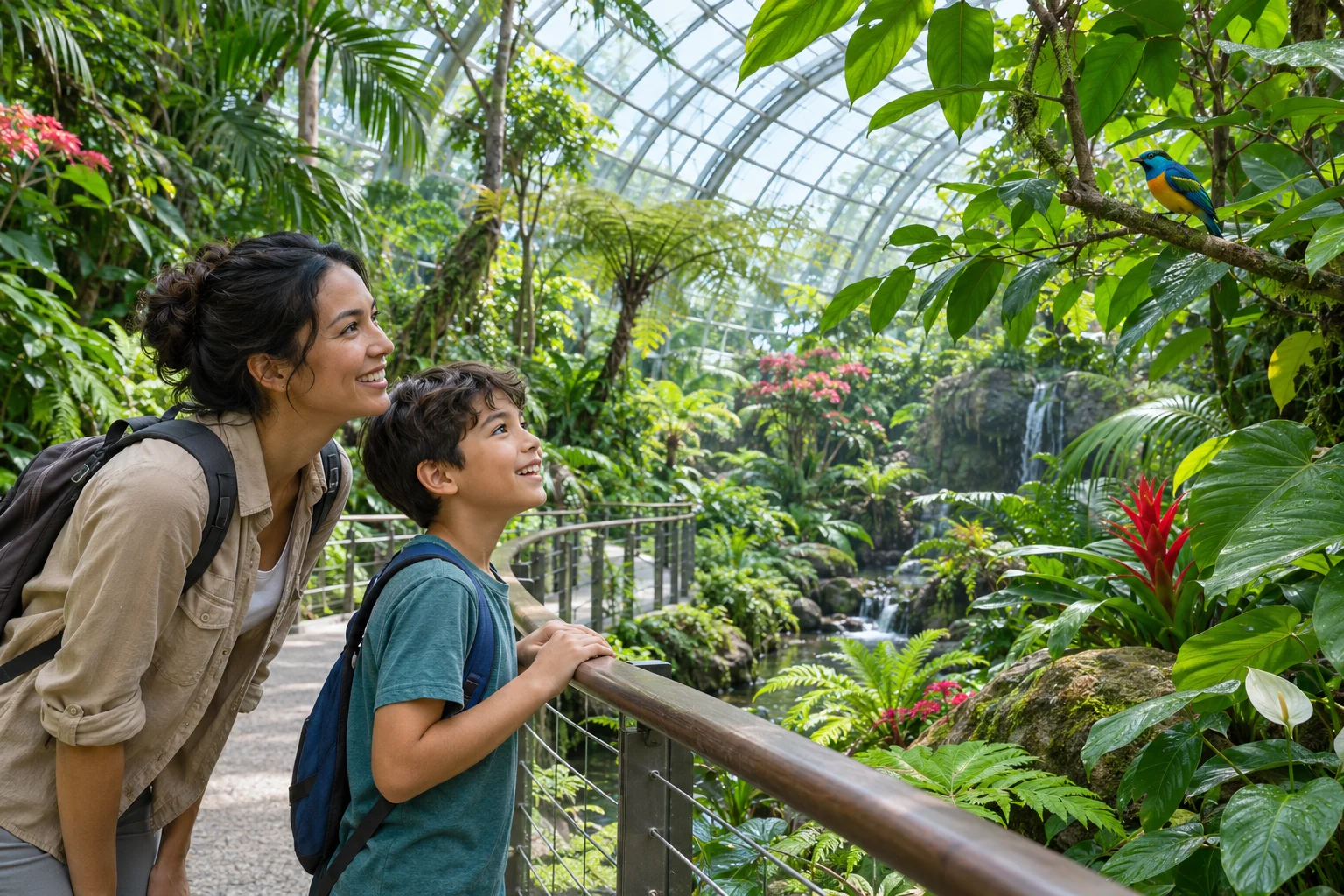
Illustrative image created for this guide; it does not show a guaranteed venue feature, booked activity or actual customer.
Choose an indoor rainforest visit for the right reasons
The Green Planet Dubai can suit travellers who want an indoor visit focused on a rainforest setting rather than another skyline view. Start with the current official ticket options, check what your selected product includes and give the visit its own space in the day. Add a meal and a clear return plan. Avoid assuming that every animal activity shown online is part of general admission.
Official visitor information describes The Green Planet as an indoor tropical rainforest biodome. That broad description helps you understand the theme, but it does not tell you every detail of the experience on your date. Specific encounters, sessions and ticket upgrades have their own conditions. Check those directly before building a child's expectations around a particular activity.
This first-visit guide is about choosing and planning the outing. It does not guarantee sightings, handling opportunities, opening hours or current prices. Wildlife experiences should be approached with patience and respect for staff instructions. A living setting is different from a display that promises the same moment to every visitor at the same time.
If your group is comparing different nature-themed days, our Dubai Safari Park guide and Miracle Garden visit guide describe separate experiences. Choose the theme that interests the group rather than buying several outings simply because all involve nature in some form.
Decide whether this visit fits your family
Ask what the group hopes to see and learn
Start with a simple conversation. Does the group enjoy looking at plants and animals, reading explanations and noticing small details? Or is it looking mainly for rides and physical challenges? Neither preference is wrong. Choosing the right type of outing is more useful than choosing a venue only because it is popular.
Give children a clear description of the visit without promising a specific animal encounter. Explain that visitors follow the venue's paths and staff instructions, and that animals do not perform on demand. A child can still look forward to exploring the setting, choosing a favourite detail and asking questions about what they notice.
Compare the theme with your other holiday days
A rainforest-themed indoor visit can create variety after heritage streets or modern towers. Think about what your trip already includes. If several days are nature-focused, you may want a different theme next. If most days involve long outdoor routes, a focused indoor experience may add a welcome change of pace.
Our Dubai neighbourhood days guide helps with the wider shape of the holiday. Keep each day manageable. A new theme does not need to be added to an already full itinerary; it can replace a lower-priority outing that the group is less interested in.
Think about comfort as well as interest
Ask the venue about the environment and route if anyone in the group has a specific access or sensory need. Explain what matters in practical terms. A broad indoor or family-friendly label does not tell you about every space, sound, surface or part of the visitor route. Use the response to decide whether the experience suits the person.
Check how non-participants or people who prefer a shorter visit can manage the day. Do not assume that every companion will want the same level of interaction or the same time inside. A good family plan allows different comfort levels without making anyone feel that they have spoiled the outing.
Read the ticket options carefully
Start with the official product description
Use The Green Planet's official day-pass information to compare the current options. Read the inclusion list for the exact product and date you want. A general description of the venue may show experiences offered across several ticket types. It is not a substitute for the terms attached to your selected purchase.
Confirm the number of guests, the relevant age categories and any proof required. If a ticket has a session or reporting time, keep it clear in your plan. Do not rely on a remembered description from another seller. Two products with similar names may have different conditions or added services.
Separate general admission from upgrades
If an upgrade interests you, ask what it actually adds. Check its duration, participation conditions, minimum numbers if any and whether it needs a separate reservation. An attractive photograph should begin the question, not answer it. You should understand the extra before paying for it, especially when buying for a family.
Compare the total you would pay with what the group wants to use. A larger package can include something you value, but it can also add services you do not need. The best choice is the one that matches the planned visit clearly. You do not need the highest ticket tier to justify choosing the venue.
Read change and cancellation terms
Check what happens if your plans change, you arrive late or the provider changes a session. Keep the actual terms with your booking. Do not assume every seller uses the same policy. If you book through another platform, understand which company manages changes and which instructions you must follow at the entrance.
A saved idea or initial enquiry is not a confirmed ticket. Wait for the provider's written confirmation and check the details before travelling. If you spot an error, contact the responsible seller promptly using its stated process. Do not buy a second ticket before understanding whether the first booking can be corrected.
Plan the journey as part of the visit
Save the correct arrival point
Use the venue's actual location and current entrance information. A wider area name is not always enough for a driver or a family walking from another stop. Save the point and check the final connection. If somebody in the group needs less walking, explain that when arranging transport and ask about the practical arrival route.
Allow time for finding the entrance and completing any entry steps. A map estimate usually describes a journey, not the entire process of beginning an attraction visit. Keep a margin before a timed session. Arriving calmly can make the first part of the experience easier for children and adults alike.
Know how you will return
Before entering, have a basic return plan and your accommodation address available. If using a booked pickup, confirm the specific meeting location and contact method. If the visit runs longer or finishes earlier, communicate the change through the agreed channel. Do not assume the vehicle can wait anywhere around the building.
Avoid putting a second distant timed booking immediately after the visit. The group may want more time inside, a meal or a quiet break. A flexible next step is easier to adapt. You can still make good use of the day without making every activity depend on the fastest possible exit.
Give children a useful way to look
Choose a small observation theme
Ask a child to notice one leaf shape, one colour and one movement. Let them explain what they found interesting. You do not need to identify everything yourself. Read the official information provided inside or ask a staff member where appropriate. Curiosity can be part of the experience without turning the visit into a lesson with a test at the end.
Older children might compare how the setting uses height, shade and different levels of vegetation. Keep explanations tied to what the venue actually presents. Do not invent a story about an animal because it is quiet or out of sight. Learning to look patiently is a useful part of a nature-themed outing.
Set expectations about interaction
Explain before arrival that visitors follow the rules for distance, touching, feeding and photography. Do not promise that a child can hold, feed or approach an animal unless the specific booked activity and staff instructions permit it. A general admission ticket should not be treated as permission for an encounter.
If an animal is not visible, give the child another thing to notice rather than encouraging them to tap, call or try to attract it. Staff guidance and animal welfare matter more than obtaining a particular photograph. A quiet observation can still become a favourite memory when the family gives it time.
Keep the route manageable
Children can become tired even when an experience is interesting. Make space for a pause and check venue rules about food, drinks and where breaks can happen. Do not wait until the whole group is hungry before thinking about the meal. A clear next step helps the outing remain comfortable.
Keep younger children with a responsible adult and agree how the family will stay together. If older travellers have a short independent window, set the meeting place and time first. The environment may be different from a standard shopping space, so make the group's contact arrangements simple and clear.
Visit respectfully around plants and animals
Follow the venue's guidance
Use the visitor paths and respect barriers, signs and staff requests. Do not pick plants, reach into an area or move closer to an animal for a better angle. Another visitor's behaviour does not establish what is permitted. When uncertain, ask rather than making the animal or surrounding environment part of an experiment.
Keep your own belongings organised and follow rules about what may be brought inside. A light bag is often easier to manage than a large amount of equipment, but check the actual venue conditions. Avoid carrying items that make it difficult to move through the route or require storage you have not arranged.
Let observation be enough
A wildlife visit does not need a close-up interaction to feel worthwhile. Watching how an animal moves or noticing the structure of a plant can be engaging. Give the group permission to slow down. You do not have to collect a photograph of every species or find every feature mentioned in a travel article.
If staff offer an explanation or scheduled activity that your ticket allows, listen to the instructions first. Do not assume you can join simply because other visitors are present. Check the conditions and give the team space to manage the activity. A clear understanding helps both visitors and staff.
Photography without pressure
Check the current camera rules
Ask about permitted photography, flash, recording and any restrictions on equipment. Follow the instructions for the area you are in. A permission in one part of a venue does not automatically apply everywhere else. Keep other visitors' privacy in mind when taking pictures in shared spaces.
Do not use a camera to draw an animal toward you or create a reaction. Take the photograph from the permitted route and accept that some moments will not be easy to capture. A blurred image is a small issue; disturbing the setting for a better one changes the purpose of the visit.
Choose a few pictures with a story
You might take a picture of the larger setting, a plant detail and the family looking at something from the visitor path. Respect anyone who does not want to appear in a public post. Keep captions honest: describe the visit you booked rather than implying exclusive access or a guaranteed encounter.
Then spend part of the visit without the screen. Ask companions what they noticed that was different from their expectations. Those conversations can help the experience stay memorable after the pictures are sorted. A good outing can include details that do not fit neatly into a social media image.
Put lunch in the plan before everyone is hungry
Check the food arrangements for your chosen ticket and the venue. If a meal option is offered, read what it includes and any conditions attached. Otherwise, choose a practical meal nearby or after returning. Do not assume food is included because a photograph shows a café or because another product offers a meal.
Ask about ingredients and preparation directly when a traveller has a dietary need. A broad package description may not answer that question. Keep enough time to eat without rushing toward another reservation. A seated meal can provide the pause that makes the rest of the day enjoyable for the whole group.
If the group wants different food, agree how to handle it before separating. Keep supervision and a meeting point clear. A simple shared option may suit the day better than searching for the perfect restaurant while everyone is tired. The meal supports the visit; it does not have to become another major attraction.
Compare the full cost
Add the selected tickets, travel, food and any optional upgrade you genuinely want. Check which price category applies to each guest. Do not assume that every seller uses the same age categories or includes the same services. Compare the total for the actual group rather than an advertised starting figure.
If keeping to a budget, decide on upgrades in advance. Explain the choice to children so they do not expect every experience shown on a sign. You can enjoy the main visit without buying every extra. A clear budget helps adults give a calm answer instead of deciding under pressure at the attraction.
Keep a small margin for ordinary practical changes, including the return journey. Do not use all the available spending on admission and leave meals or travel as an afterthought. The value of the outing depends on whether the whole day fits the group, not simply on how many features appear in the ticket description.
Choose a sensible second part of the day
Keep it light after the main visit
A meal, a short look around a nearby area or a return to the accommodation may be enough. Check the actual connection before adding another place. A destination being nearby on a city map does not mean its entrance is a short comfortable walk. Give the group a choice after you know how much energy remains.
If the holiday already includes Downtown, our Downtown day guide can help you keep that fuller visit on another day. A clear theme often works better than mixing an indoor rainforest, an observation deck and a long waterfront route into the same afternoon.
Save a different setting for tomorrow
For a heritage day, consider our Old Dubai walking route or Al Seef guide. For a modern waterfront, the Marina and JBR evening guide offers another theme. Confirm current details for each separate outing.
You can also use our viewpoint comparison when the group wants a skyline experience. It is a different reason to buy a ticket. Choose it because the view interests you, not because it appears on the same list as the rainforest visit.
Make your enquiry easy to answer
Provide the date, number of guests, ages where required and the exact ticket or activity you mean. Mention transport needs separately. Ask for the full amount, inclusions and change terms. Explain any important participation or access question directly so the responsible provider can answer it before payment.
Keep the seller's confirmation and the venue's entry instructions together. Read them again before leaving. If a session time or meeting point changes, share the latest instruction with the other responsible travellers. A clear plan lets you spend the visit observing the setting rather than checking several different messages for the next step.
After the visit, ask each person to name one thing they noticed. It might be a colour, a sound, a plant or a question they want to explore later. That small conversation can give the outing a clear ending. You do not need to add another activity to prove that the day was useful.
Use a simple observation plan instead of chasing every feature
Before entering, ask each traveller to choose one thing they would like to notice. A child might choose colours, an adult might choose leaf shapes and another person might watch how the different parts of the setting are arranged. These themes do not require a special ticket or a guaranteed animal sighting. They give the visit direction while keeping attention on what is actually available to observe.
At a suitable pause, compare what people found. Let the venue's explanations answer factual questions and keep guesses clearly separate. If you do not know something, say so and note the question for later. A family can learn together without one adult having to provide an answer to every question immediately.
For a teenager interested in photography, agree on a small photo story from permitted places. A wider scene, a plant detail and a picture of the group looking can be enough. Check equipment and recording rules first. Avoid making the whole visit depend on one animal appearing in the exact position needed for a photograph.
Make patience part of the experience
A living setting rewards a different pace from a ride with a fixed start and finish. Some details are easy to miss when you move quickly. Stop where permitted, look carefully and let other visitors pass. The aim is not to remain in one place so long that you block the route; it is to notice something before moving to the next part.
If a child feels disappointed about an animal they did not see, acknowledge it without promising an encounter later. Offer another observation or a question to ask staff when appropriate. The visit can still hold something interesting. Do not encourage noise, tapping or feeding as a way to turn disappointment into a sighting.
Review upgrades without pressure
If the group sees an extra activity it had not planned, pause before deciding. Check the product, available session, participation conditions and full cost. Ask whether the activity fits the remaining time and whether everyone wants to join. You do not need to answer immediately simply because the offer appears inside the attraction.
A family budget should include the return and food before optional extras. Explain this to children in a simple way. Choosing the original plan is a valid decision, even when another activity looks attractive. The purpose of comparing tickets beforehand was to choose what matters, not to feel obliged to keep upgrading during the visit.
Bring the learning home without another purchase
Afterward, each person can name one thing they would like to understand better. Look for an appropriate educational or official source when you have time. You could compare a plant's shape with one seen at home or talk about the difference between a managed visitor environment and a natural rainforest. Keep the discussion tied to reliable information rather than inventing facts from memory.
A drawing, a short note or a shared conversation can be a souvenir of the outing. You do not have to buy an object to prove the day was memorable. Let the visit be one chapter of the holiday and choose a different pace for the next day if the group wants it. A varied trip gives people time to absorb experiences as well as collect them.
Frequently asked questions
What kind of attraction is The Green Planet?
Official visitor information describes an indoor tropical rainforest biodome. It is a nature-themed visit rather than a general ride park. Check the current official product information for the experience you want. Specific activities, upgrades and sessions may have separate requirements and inclusions.
Is every animal encounter included with admission?
Do not assume that. Read the selected product's inclusion list and ask about any encounter separately. Check its booking and participation conditions. An image on a venue page may show an activity offered with another ticket. Confirm the details before promising it to a child.
Can children enjoy a general visit?
Children who enjoy looking at plants and animals may find the setting interesting. Give them a simple observation task and keep the route manageable. Check the actual age and supervision rules for the chosen product. A family label does not answer every activity requirement.
Are animal sightings guaranteed?
This guide does not guarantee a particular sighting or behaviour. Follow the venue's information and staff instructions. Approach the visit with patience and notice the wider setting too. Do not try to attract an animal, cross a barrier or create a reaction for a photograph.
What should I check before booking?
Confirm the exact ticket, date, time requirements, guest categories, inclusions and change terms. Ask important access or participation questions directly. Keep the entry instructions with the confirmation. A saved idea or general enquiry should not be treated as a confirmed reservation.
Is the visit automatically easy for limited walking?
Ask about the actual visitor route, surfaces, lifts, seating and any support needed. Explain practical requirements rather than relying on an indoor label. Use the venue's current response to decide whether the experience suits the traveller and which version of the visit to plan.
Can we take photographs?
Follow the current rules about cameras, flash and recording in each area. Respect other visitors and animal welfare. Take pictures from permitted paths without trying to change an animal's behaviour. Ask staff if uncertain, and accept that some moments are better enjoyed without a camera.
Does the ticket include food?
Only if the specific product says so. Check the meal details and any conditions when an option is offered. Otherwise, plan food separately. Ask dietary questions directly with the food provider. A café photograph or another visitor's package does not confirm your own inclusions.
Should we add another major attraction afterward?
Start with a flexible meal or short extra rather than another distant timed booking. Count travel and the whole visit, not only time inside. Decide from the group's remaining energy. Saving a different theme for another day can make the holiday more varied and comfortable.
What is a simple first-visit plan?
Choose the right ticket, confirm the entrance and allow time to arrive calmly. Explore at a manageable pace, follow the venue rules and include a meal break. Keep the return plan clear. A focused visit can be complete without buying every upgrade or filling the evening.